Yes, I know this will not be a shock to many of you. I’m certainly not the first open source maintainer to take this step. I apologize in advance for the pain/work this will cause some of you - I’m doing my best to minimize that. I appreciate all of you who have contributed to these projects in many ways. I mean that - there have been hundreds of contributions in the form of issues opened, PRs filed, people leaving stars. Thank you.
Overview (TL;DR)
Some Ardalis NuGet packages (details below) will be moving to commercial licensing in late 2026 or early 2027. These will be licensed as a suite and will continue to be free (with license) for most use cases. The licensed products will be distributed by NimbleTools once they are available. NimbleTools is a new company my wife and business partner Michelle and I are creating - I haven’t sold out to some external buyer.
While most projects using these packages will continue to be able to do so free of charge, larger organizations will need to purchase a commercial license to continue using the latest versions of these packages. Existing versions will of course remain free and I’m even committing to publishing one more free version of each in 2026 before the commercial package bundle becomes available.
The packages will be getting a number of new features, including several that are generally of interest to larger enterprises. Also, additional packages will be joining the suite very soon, and other products will follow from NimbleTools. The Ardalis.Result package will remain free.
More details will be forthcoming - if you want to ensure you are notified please
add your email address here. Your email
address will not be sold or otherwise misused - this only signs you up to
receive updates related to the Ardalis packages and their new counterparts under
the NimbleTools brand (so expect emails to come from either me or a
nimbletools.io email address).
Also, we plan to offer initial customers a significant discount - details will be public but will surely go out to email subscribers if you want to be sure not to miss that.
What This Means for You
Individual developers, students, hobbyists, open source maintainers, and companies and non-profits under $5M in annual revenue/budget will be able to use the commercial versions for free with a community license.
| If you are… | What changes |
|---|---|
| An individual developer, student, or hobbyist | Nothing you need to pay for. Grab a free community license when you upgrade to a commercial version. |
| An open source project | Nothing you need to pay for. Free community license. |
| A company or non-profit under $5M revenue/budget | Nothing you need to pay for, as long as you also haven’t raised over $10M in outside capital. Free community license. |
| A larger company, government agency, or school | Budget for a commercial license in 2027 if you want new versions. Current versions (and one more free release in 2026) stay free to use. |
| A consultant or agency building software for clients | Eligibility is based on the client who will own the software, not on you. |
| Using Ardalis.Result | Nothing. It stays free and open source. |
| Someone who has contributed issues, PRs, or docs | Thank you! The existing repos and their history stay public and MIT licensed. Once development moves to NimbleTools, they will link to the new repos and be archived. |
| Not ready to decide | No rush. Nothing changes until you choose to upgrade, and there are no runtime checks or “phone home” behavior in the licensed versions. |
The Obvious Questions - Why and Why Now
There’s just no time.
I used to have time I could put toward these open source projects on a regular basis. Like so many other open source maintainers, I feel the nagging guilt of open issues and worse, open pull requests hanging over me, but my life has changed. And of course it’s not just me - my family situation has changed, the businesses my wife Michelle and I run have changed. The world has changed - a lot - in the last 5-10 years.
NimblePros (which my wife Michelle and I cofounded) has occasionally used its team of employees and contractors to work on some of these projects. I would like the ability to keep a regular group of maintainers focused on these tools, and to be able to compensate them accordingly in a sustainable manner.
I still like building things, learning things, teaching things, and sharing things. I like that I can create things that others find useful, and I like collaborating with smart people to do so. But I don’t have as much luxury today to spend enough time on that just because I enjoy it. Something has to give. Some of you reading this may have noticed, or I’ve shared with you, how I just haven’t been spending much time on these packages. And this kind of unintentional “quiet quitting” isn’t really fair to the thousands of developers who are using these packages.
This is my attempt at changing that and providing the most benefit for the largest number of people impacted. The packages will be better. The vast majority of users will benefit from these improvements free of charge. A team of paid developers will be available to provide much faster support and regular new features. Even the companies we expect to pay for licenses will benefit from having proper support, more enterprise features, and improved security.
Why now? Well, I would have done it sooner but I didn’t have time! It takes a lot of work to actually get to this point, and I’ve had to really prioritize to make it happen at all. I’d set personal goals of publishing this announcement pretty much monthly since spring of 2026 (and that’s after having discussed the idea for several years before) and failed to make any of them.
So now it’s October but better late than never.
What to Expect
I’m planning to make these relatively popular NuGet packages (and their sub-packages) a suite of commercially-licensed tools.
- Ardalis.GuardClauses
- Ardalis.SmartEnum
- Ardalis.Specification
While they will require a license, community licenses will be free of charge and available to the vast majority of users. Larger organizations making over $5 million in gross annual revenue, or having received over $10 million in capital investment from private equity or venture capital will not qualify. Nor will government agencies, universities, colleges, trade schools, or non-profits with an annual total budget exceeding $5 million. When software is used on behalf of another organization, the ultimate owner of the software produced determines license eligibility.
When to Expect a Change
I know in some cases, open source packages have undergone a change of ownership or license with very little (or no) advance notice, causing a lot of stress and consternation among their users. I know, I’ve been involved in updating client code to move from one package to another and address any gaps because of a sudden license change.
My goal is to avoid causing any emergencies for any developers to have to deal with. The commercial offering will be available no earlier than mid-December 2026, and possibly not before 2027.
Again, there’s only so much time and there’s a lot to do, but I know folks want to be able to plan, which is why I’m publishing this before everything is done and ready to go.
Even when the commercial offering is available, nothing compels you to make any change. You can stay on the current version forever, and I’m even committing to publishing another free version of each package before the end of 2026 with bug fixes, updates, and any .NET 11-related features that may be in the works.
You have time. I hope this isn’t causing anyone to have to deal with an emergency.
How will this play out?
The plan is to roll out versions of each of the three packages (and their related packages) with a new license, and once a project is upgraded to that version of the package, it’s subject to that new license. In addition, at compile time, if no valid license is found, a compiler warning will indicate that the license is missing and how to license the package(s).
We don’t have any runtime checks, no “calling home”, no runtime performance or security overhead at all. Why do we expect anyone to bother getting a license? Because most professional engineering teams treat warnings as errors (but of course one can suppress individual warnings) and, more importantly, because big organizations generally like to comply with license laws, in my experience. If we can make the purchasing process as painless as possible, the hope is enough companies will take the easy path of purchasing a license rather than adding to their own software maintenance burden (or illegally using the software under a community license).
The existing GitHub repos and all of their commit history will remain with their current MIT license. Once active development has moved to a NimbleTools organization repo, the Ardalis repos will be updated to link to the new locations and archived.
Will I need a license key?
Under the new license, all use will require a key. Registration for a community license key will be free of charge and fairly painless. Keys will work offline and in CI/build agent scenarios.
What will pricing look like?
Pricing is still being determined, but the plan is to use annual, team-based pricing, not per-developer. Our goal is to limit the pain of having to pay for licenses as much as possible, and ideally restrict that (minimal) pain to companies who can afford to buy licenses for tools that help them deliver quality software.
Early customers will receive a significant discount.
What new features are we getting?
We haven’t nailed down everything, yet, but in general these are the additions we’re anticipating:
- Custom agent skills with recommended usage for each tool
- MCP Servers
- Benchmarks and Performance Optimizations
- Analyzers and Code Fixes
- Source Generators (where appropriate)
- Software Bill of Material (SBOM) support
- Signed packages (author and repo signed)
- Deterministic and reproducible builds
- Artifact attestations
In addition we will be providing better docs, samples, and support options.
Can’t everyone just code these themselves with AI?
I mean, sure, but we’re talking about open source MIT-licensed projects. Save your tokens! Download the actual battle-tested source code right now:
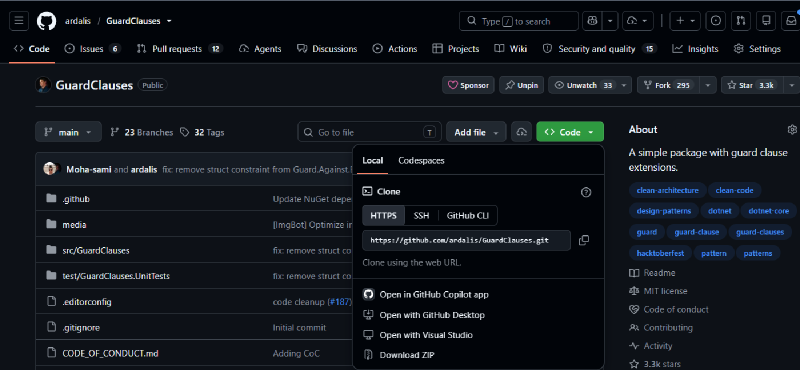
Developers have always had the power to just copy open source code into their repo and use it directly - no NuGet packages, no external dependencies. The trade off is, now it’s your code to manage. It’s your code to share among multiple apps. It’s your code to version. It’s your code to patch and fix. And I’m sure it’s highly unlikely that your organization would miss any vulnerabilities that might otherwise have been found by the thousands of other users of the shared library version. There are clearly trade offs involved between building everything yourself and using Free Open-Source Software (FOSS) or Commercial Off-The-Shelf (COTS) software which comes with the possibility of support. It’s the classic Build vs Buy question, and each org needs to make their own decision. AI makes the first step of building easier, but the long tail of costs go beyond just time spent writing/generating code.
Where can I learn more?
Join the mailing list, keep reading this blog, keep an eye on nimbletools.io, and consider joining our new NimbleTools Discord Server.
Acknowledging a Trend
There has been a trend in open source that this is a larger part of. You can find examples going back further, but if we only go back as far as 2020 you’ll see:
- IdentityServer -> Duende Software (2020) (now $5,750-$24,900/yr)
- MediatR/AutoMapper -> Lucky Penny Software (2025) (now FREE-$6,399/yr)
- MassTransit -> Massient (2025) (now $4,000-$12,000/yr)
- Fluent Assertions 8.0 (2025) (now $14.95-$129.95/dev/yr)
Not every open source maintainer who finds themselves unable to keep up with the demands of their creation(s) goes the full-on commercially licensed software company route. Some try to rely on sponsors:
- NUKE Build (2025) announces move to minimal new updates due to “the well-known OSS sustainability problem”
- FastEndpoints (2026) announces move to bugfix only mode citing lack of sponsorships and financial support
And still others are moving toward an Open Source Maintenance Fee:
- Rob Mensching / WiX Toolset (2025) - Rob invented the OSMF and is dogfooding it on his WiX toolset
- Polly / appVNext (2026) - Earlier this year popular resilience library Polly announced it was adopting the OSMF
A lot of open source has been unsustainable for a long time. I think if you want to be able to spend the time needed to produce quality software suitable for use by professional organizations, there needs to be some exchange of value. I think a lot of folks who aren’t profiting off of their use of the tools can enjoy the benefit of free access provided that larger organizations pay a reasonable amount for the value they receive.
Why not use OSMF?
The idea behind the OSMF is simply to provide some compensation to open source maintainers for making packaged distributions of software available. That’s something, but it falls short of offering software that enterprises can trust and rely upon, with support, security guarantees, and more. My hope is that enough enterprises will see the value in these tools that it will enable us to expand their capabilities, benefiting all users.
Companies are Starting to Assess the Risk
I didn’t make it to NDC London earlier this year (2026), but I did catch the recording of this talk afterward. If you’ve read this far, you may want to have a look:
Open Source is Broken and it’s Our Fault
The initial premise is simple: not sustaining open source projects leads to burnout and is a legitimate risk of that project becoming unavailable, not fixing critical issues, or worse, possibly transferring ownership to a state actor who plants malware in a future version (no really – this happened).
The talk concludes with a set of tools you can use with the help of an LLM to assess the risk of the open source projects your organization uses. This provides a kind of risk assessment your organization can use to identify which projects it depends on are most at risk. The assessment prioritizes which projects an organization should most consider assisting, most likely financially but possibly with employee time or other support.
Naturally I ran the assessment on my own projects (in March 2026 - I did mention I’ve been meaning to publish this post for a while, right?), and here are the results (edited down for size).
Summary Table (March 2026 Snapshot)
| Rank | Repository | Stars | Open Issues | Open PRs | Sponsors | Last Commit | Score | Funding Gap |
|---|---|---|---|---|---|---|---|---|
| 1 | ardalis/SmartEnum | 2,397 | 75 | 11 | 2 | Jul 2025 (8mo) | 11 | Severe |
| 2 | ardalis/GuardClauses | 3,285 | 8 | 3 | 2 | Jan 2025 (14mo) | 8 | Severe + Inactive |
| 3 | ardalis/Specification | 2,210 | 17 | 0 | 0* | Nov 2025 (4mo) | 6 | High |
| 4 | ardalis/Result | 1,020 | 34 | 3 | 2 | Nov 2025 (4mo) | 3 | Moderate |
Ardalis.SmartEnum Score: 11/15
Recommendation: Highest funding priority in this set.
Bus Factor: ardalis accounts for 63% of all commits (82% excluding bots). Effectively a solo project. No co-maintainer with meaningful contribution.
GitHub Sponsors: 2 (ardalis), 0 (repo) - severely underfunded
Health Indicators:
- 75 open issues
- 11 open PRs
- Last commit July 2025
- Recent slowdown in commits suggests bandwidth issues
- No burnout messaging in README, but the issue backlog speaks for itself
Ardalis.GuardClauses Score: 8/15
Recommendation: High priority; note reduced activity over the past year
- Bus Factor: ardalis 69% of human commits - effectively solo
- Last meaningful commit: January 2025 (14 months ago)
- Funding gap: 3,285 stars with only 2 sponsors (ardalis - 0 repo sponsors); severely underfunded
Most popular repo in this set but most inactive. The combination of high popularity + low funding + reduced activity is a classic pre-abandonment pattern.
Ardalis.Specification Score: 6/15
Recommendation: Medium priority; note primary maintainer is fiseni, not ardalis
- Bus Factor: 84% of commits in the last 12 months were fiseni; only 2 were ardalis, 14% were sadukie
- GitHub Sponsors (repo or fiseni): 0
- Open Issues: 17
- Open PRs: 0 (good, keeping up)
Key Signals:
- The most actively maintained repo in this set, but the person doing the work has no funding infrastructure
Author note: Both fiseni and sadukie are paid contractors/employees of NimblePros, which ardalis co-owns, though to be clear fiseni had not thus far been paid for his contributions to this repository (though that is about to change)
Ardalis.Result Score: 3/15
Recommendation: Low urgency, smaller, not yet overwhelmed
- Bus Factor: ardalis: 58%, KyleMcMaster: 9%, ShadyNagy: 6%; more distributed so lower bus factor risk
- GitHub Sponsors: 2 (ardalis), 0 (repo)
- Open Issues: 34 (moderate backlog)
- Open PRs: 3
Key Signals:
- Healthiest team composition of the group
- Moderate issue backlog but not alarming
- Smallest user base -> lowest priority for intervention
Author note: Both KyleMcMaster and ShadyNagy are paid contractors/employees of NimblePros, which ardalis co-owns.
The overall recommendation was that if the org is using these packages, they should consider sponsoring ardalis, and encourage fiseni to set up GitHub Sponsors so they could sponsor him as well.
Summary
If you read this far, thank you. If you haven’t already, and you want to get updates about this topic as things progress, sign up for email updates. I promise I don’t sell anyone’s info, nor do we spam you with daily offers or anything like that.
I want to have the time and resources to continue adding features to these projects. I want to bring a few new ideas into reality. I’ve seen other open source maintainers make this move successfully, and that’s been inspiring and I appreciate those who came before me for their courage. It’s possible that that ship has sailed and with the current state of AI, the market for commercial software is about to evaporate. But I hope that’s not the case, and I hope some of you will come with me as we explore what building enterprise-worthy software tools looks like in 2027.
Resources
- Duende Software hello post
- Jimmy Bogard — AutoMapper/MediatR going commercial
- MassTransit v9 announcement
- Fluent Assertions 8.0 releases
- NUKE build discussion
- FastEndpoints v7.2
- UseWhatWorks.org — Broader OSS sustainability movement
- Milan Jovanović — MediatR and MassTransit going commercial
- Open Source is Broken, and It’s Our Fault (YouTube)
- oss-health-skills
- The Cost of Free Software (YouTube)